


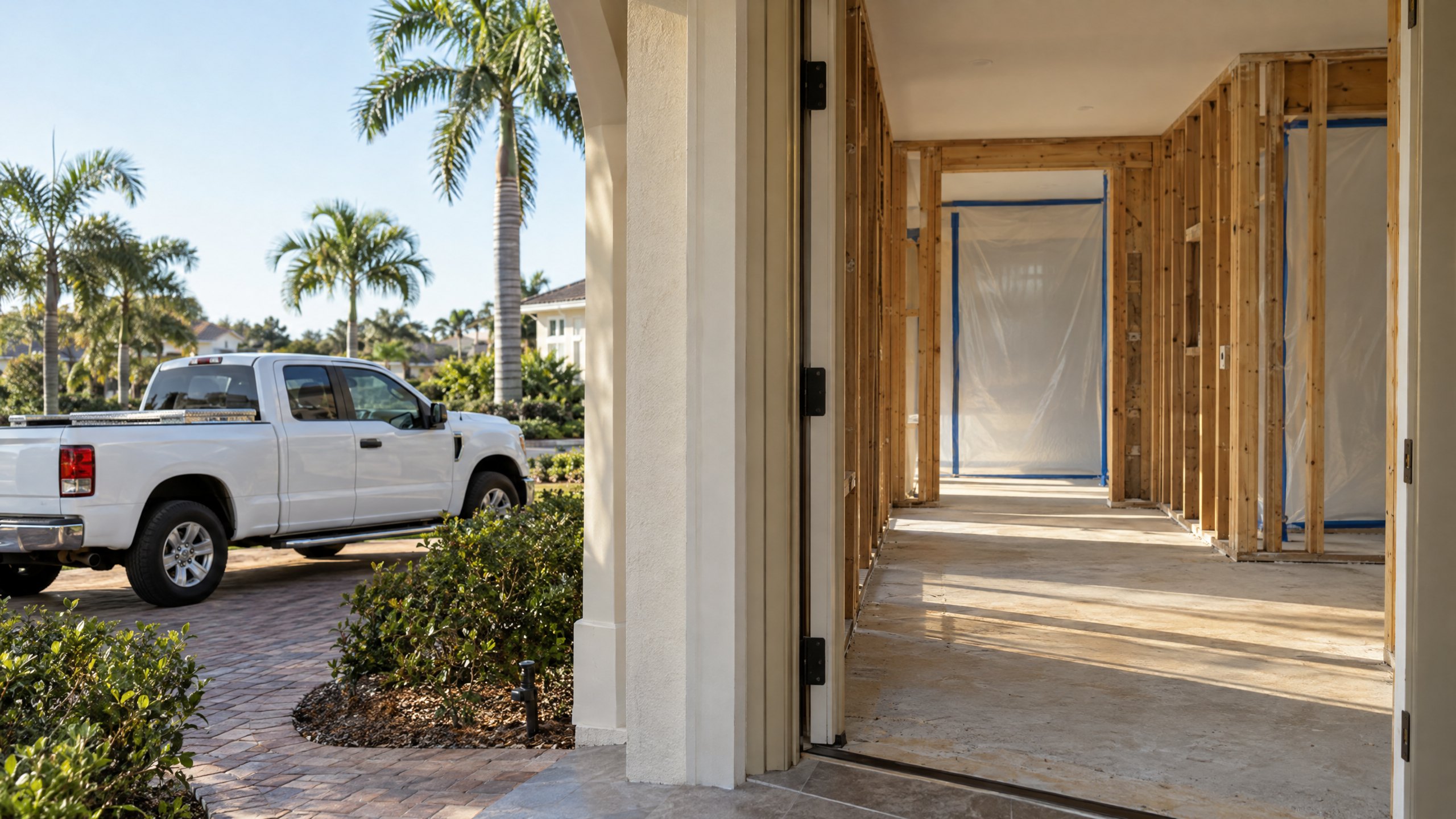
Quick answer
Quick answer: Florida Statute 468.8419 bars a licensed mold assessor from performing or offering to perform remediation on a structure their company assessed within the previous 12 months, and it bars a remediator from assessing a structure they remediated. The separation exists so nobody can find the problem and sell the cure. But the statute carves out certified Division I contractors, meaning the general, building and residential classifications under Florida Statute 489.105(3). That exemption is why a licensed general or building contractor can occupy a role a dedicated mold company legally cannot, and almost nobody explains it to property owners.
If you have had mold removed from a Florida property, the rebuild is a separate job from the remediation, and who may legally perform which part is governed by a licensing scheme most owners encounter for the first time while standing in a gutted bathroom.
Here is the part that matters to you.
What does Florida actually require for mold work?
Florida licenses individual mold assessors and individual mold remediators. The Department of Business and Professional Regulation does not license mold assessment or remediation businesses, only the people. A company offering both services needs two licenses held by its people, one as an assessor and one as a remediator.
Under Florida Statute 468.841, persons acting within the scope of their authorized practice under other codes or statutes are exempt. Construction Industry Licensing Board licensees may perform mold related work that falls inside their existing license scope. What the exemption does not permit is holding yourself out for hire as a licensed mold assessor or remediator, or using a title implying that licensure, without the license.
That distinction is subtle and it is the one unlicensed operators blur after a storm.
What is the 12 month separation rule?
Florida Statute 468.8419 sets it out in both directions.
A mold assessor may not perform or offer to perform mold remediation on a structure where the assessor or the assessor's company provided a mold assessment within the last 12 months. A mold remediator faces the mirror image restriction on performing an assessment for a structure they remediated.
The statute goes further on related conflicts. An assessor may not inspect for a fee any property in which the assessor or their company holds a financial or transfer interest. Neither party may accept compensation, inducement or reward from the other for referrals. And an assessor may not take an engagement where the fee is contingent on the conclusions of the assessment.
The logic is straightforward. If the person who tells you how much mold you have is also the person who gets paid to remove it, the incentive is obvious. Florida removed it.
What is the Division I exemption?
This is the provision that is almost absent from consumer content on the subject.
Both 12 month bars contain the same carve out: the paragraph does not apply to a certified contractor classified in Florida Statute 489.105(3) as a Division I contractor. Under that statute, contractors are subdivided into two divisions, with Division I consisting of the general contractor, building contractor and residential contractor classifications, and Division II consisting of the specialty trades including roofing, plumbing, mechanical and the rest.
So a certified general, building or residential contractor sits outside the 12 month restriction that binds a dedicated mold assessor or remediator.
- Licensed mold assessor: Bound by the 12 month separation
- Licensed mold remediator: Bound by the 12 month separation
- Certified general contractor (Division I): Exempt
- Certified building contractor (Division I): Exempt
- Certified residential contractor (Division I): Exempt
- Roofing, plumbing, mechanical and other Division II specialties: Not a Division I exemption
There is a consumer protection attached. The statute permits the department to adopt rules requiring that where such a contractor performs both roles, the homeowner's contract discloses the right to request competitive bids. If you are offered both services by one Division I contractor, you are entitled to shop the work, and a contractor who makes that awkward is answering the question for you.
Why does this matter to your rebuild?
Because the handoff is where mold jobs go wrong.
The sequence on a correctly run Florida mold project is: identify and stop the moisture source, assess, contain, remediate, verify, then rebuild. The verification step is the one owners skip, and skipping it is how you pay for the same wall twice.
Our post on why reconstruction should never start before drying is complete covers the documentation side of that handoff in more detail.
What goes wrong in practice is almost always one of three things.
Rebuilding before the cavity is documented dry and clear. New drywall over a substrate that still carries moisture or growth reproduces the problem inside a finished wall, where you will not see it until the smell comes back.
Nobody owning the moisture source. Remediation removes the growth. If the supply line, the condensate drain, the flashing or the grading that caused it is untouched, the clock starts again the day the wall closes.
A gap between crews. Containment comes down, the building sits open, dust migrates into clean areas, and the reconstruction scope grows for reasons that have nothing to do with the original loss. Keeping containment standing until the rebuild mobilizes is cheap insurance.
What should you ask before signing a mold related rebuild?
Four questions, and the answers tell you most of what you need to know.
Ask who performed the assessment and who performed the remediation, and whether either holds a financial interest in the other. Ask to see the post remediation verification, in writing, with the date and what was measured. Ask what was identified as the moisture source and what was done about it, specifically. And ask for license numbers, then check them yourself at myfloridalicense.com.
A firm doing this properly has all four answers ready. A firm that treats the questions as an obstacle is showing you how the project will go.
When is a contractor the wrong call?
When you need an assessment rather than a rebuild.
If you suspect mold but nobody has looked, the right first call is an independent licensed mold assessor, not a contractor. An assessment that comes from a party with no interest in the remediation scope is worth more than one that does not, and that is true even where the law permits the same firm to do both. The Division I exemption makes something legal. It does not make it the best arrangement for every owner, and we would rather say that plainly than pretend otherwise.
There is also a health dimension that sits outside construction entirely. If someone in the building is experiencing symptoms they associate with the exposure, that is a conversation with a physician, not with a contractor. We can tell you what is in the wall. We cannot tell you what it is doing to you.
Frequently asked questions
Can one company both test for mold and remove it in Florida?
Florida Statute 468.8419 bars a licensed mold assessor from remediating a structure their company assessed within 12 months, and the reverse. Certified Division I contractors, the general, building and residential classifications, are exempt from that restriction.
Does Florida license mold companies?
No. The Department of Business and Professional Regulation licenses individual mold assessors and individual mold remediators, not businesses. A company offering both needs people holding both licenses.
What is a Division I contractor?
Under Florida Statute 489.105(3), contractors are divided into two divisions. Division I is the general, building and residential contractor classifications. Division II is the specialty trades, including roofing, plumbing and mechanical.
Do I have the right to get competitive bids?
The statute permits the department to require that where an exempt Division I contractor performs both the assessment and the remediation, the homeowner's contract disclose the right to request competitive bids. Asking for them is reasonable in any case.
When can rebuilding start after mold remediation?
After the moisture source is corrected and post remediation verification documents that the area is dry and clear. Closing a wall before that is documented is how the same wall gets paid for twice.
What if the mold came back after a rebuild?
It usually means the moisture source was never corrected, or the cavity was closed before it was dry. Both are documentation questions, so ask for the verification record and the moisture readings taken before the walls were closed.
Get the rebuild sequenced correctly
SP Reconstruction rebuilds after water, mold, fire and storm loss throughout Florida, from the Panhandle and North Florida through Central Florida, the Gulf Coast, Southeast Florida and the Keys. We are a licensed Florida contracting firm, CBC1261730, an IICRC Certified Firm, OSHA compliant and following NAHB guidelines.
This article summarizes Florida statutes as of October 2026 and is general information, not legal, medical or insurance advice. Licensing requirements change. Verify current requirements and any license with the Florida Department of Business and Professional Regulation.
For post-loss work, see Rebuild Post Loss, and for the broader handoff from cleanup to completion, read Reconstruction Is the Missing Link Between Cleanup and a Finished Property.
Call SP Reconstruction at (877) 716-1520 for a comprehensive evaluation, and let us restore your property to its full potential.
Fire and Storm Reconstruction: What Happens After the Emergency Is Under Control
Learn how fire and storm reconstruction connects emergency stabilization, cleanup, and rebuilding after property damage.
Plaster Walls After Water Damage: Repair Them or Switch to Drywall in an Older Florida Home?
Wet or cracked plaster in an older Tampa Bay home? Here is how to decide between repairing plaster and switching to drywall, and what to test before demo starts.


